Research theme
Mathematical Foundations of Learning, Representation & Reasoning
What information should a learning system preserve—and how can we determine whether its representations are useful?
My research investigates the mathematical principles underlying learning and representation. Drawing on information theory and statistical decision theory, I study how representations retain task-relevant information, how their usefulness can be compared, and how knowledge can be transferred across models.
The objective is to connect the design of learning systems with precise questions about information, sufficiency, and downstream decisions.
Key questions
- What makes one representation more useful than another?
- How can information-theoretic principles guide learning objectives?
- How can multiple models contribute to reusable representations?
Selected contributions
NeurIPS · 2024
When Is an Embedding Model More Promising Than Another?
Comparing representations through their potential usefulness across downstream tasks.
NeurIPS · 2025
Learning Task-Agnostic Representations through Multi-Teacher Distillation
Investigating how knowledge from multiple teachers can support representations that remain useful across tasks.
Machine Learning · 2023
The Role of Mutual Information in Variational Classifiers
Examining the role of mutual information in classification objectives and learned predictive representations.
ICML · 2022
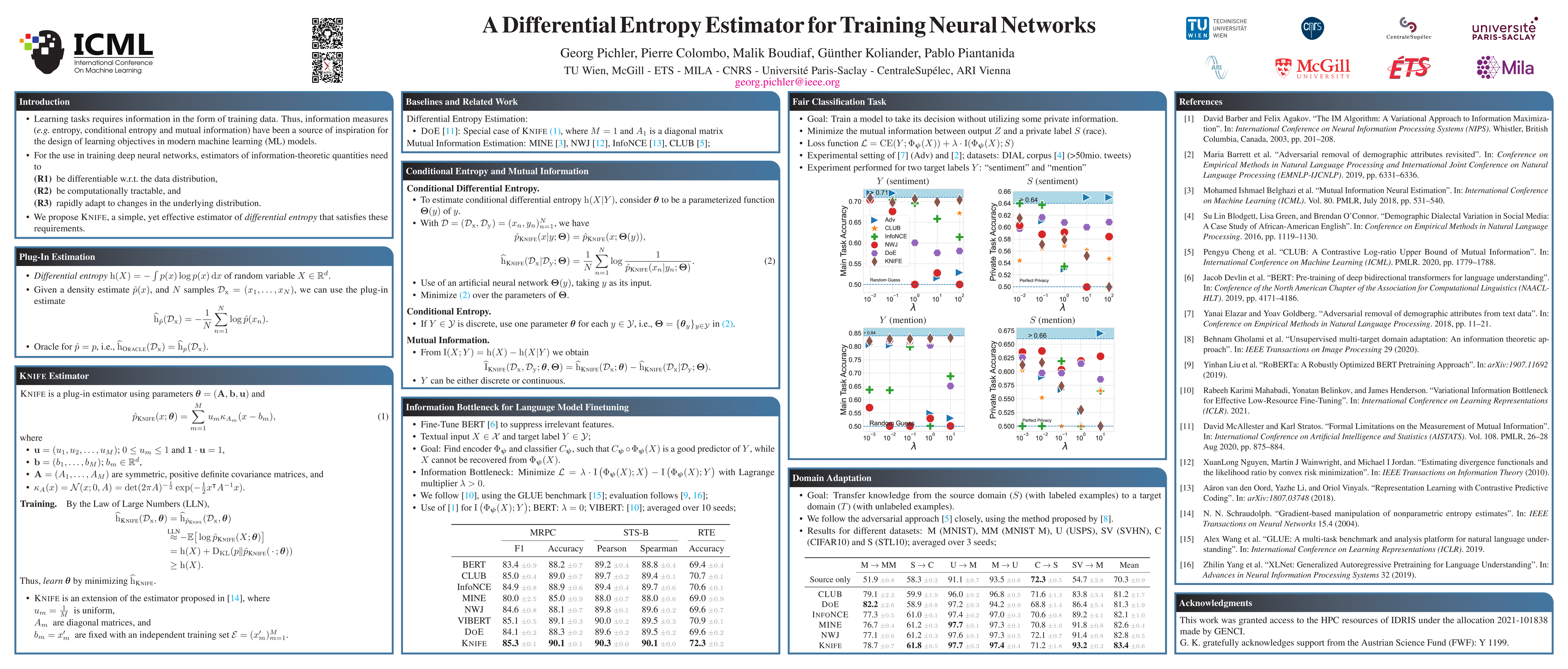
A Differential Entropy Estimator for Training Neural Networks
Connecting continuous information measures with objectives used to train neural networks.