PhD in Human-Guided Evaluation of Generative AI Systems
← Prospective students and researchers




REGARD project · Pablo Piantanida and Jackie Cheung
Possibility of a cotutelle between Université Paris-Saclay and McGill University
How can we test AI systems for the situations that matter?
A language model can perform well on a benchmark and still fail in a conversation that matters to a user. How should we test a system for rare but consequential failures? Which scenarios reflect its intended use? When is an expert’s judgment essential, and how can we use a limited evaluation budget effectively?
This PhD will develop adaptive evaluation methods that combine realistic test scenarios, probabilistic risk assessment, and targeted human feedback. The aim is to produce evidence about generative AI systems that reflects both their deployment context and the requirements of the people who use them.
The research opportunity
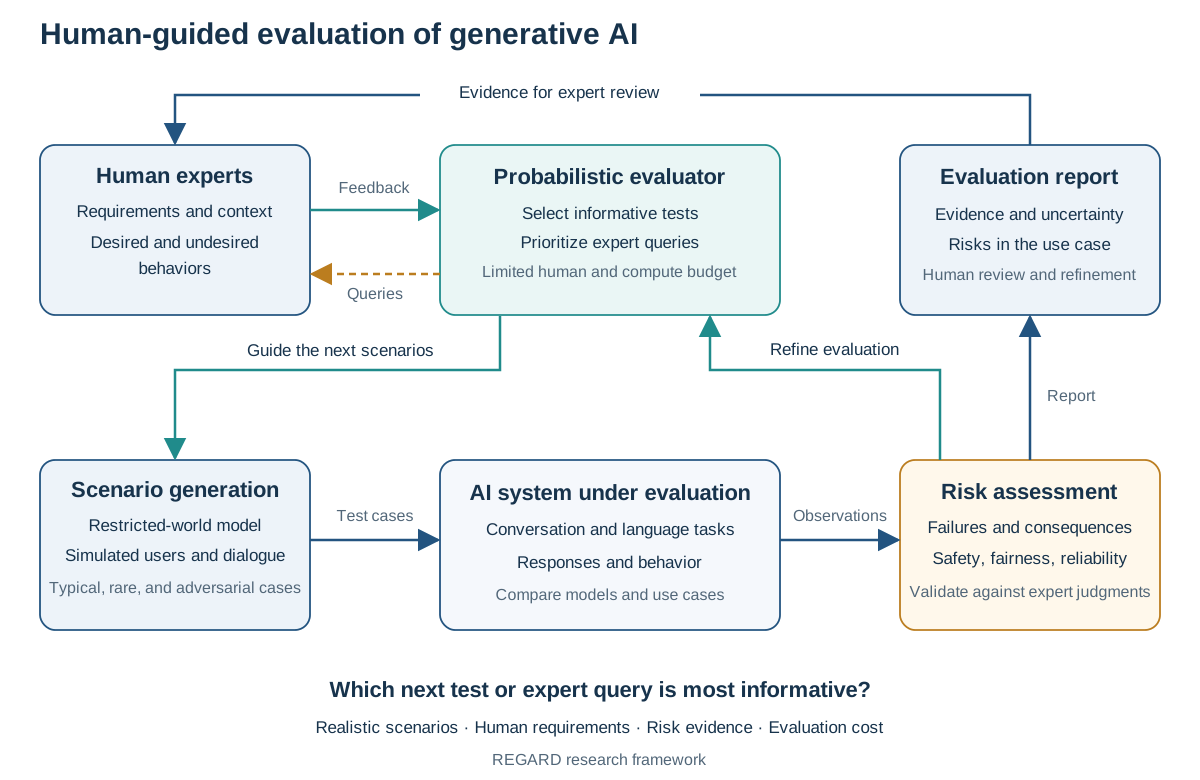
The work is part of REGARD — Robust Evaluation of Generative AI in Real-World Environments. REGARD investigates a human-guided probabilistic evaluator, an interactive system that helps experts specify desired and undesired behaviors, explore realistic test situations, and assess the resulting risks.
The doctoral research will focus on how to choose informative evaluations and allocate expert attention, drawing on the scenario-generation and validation methods developed within the project. For example, an evaluator could simulate a difficult conversation, identify an uncertain or potentially harmful response, ask an expert a targeted question, and use that feedback to refine subsequent tests.
A central question is which next test or expert query will most improve our assessment of a system’s risks, given a limited budget?
Questions you could explore
- From human requirements to evaluation criteria. How can expert descriptions of expected and undesired behavior become measurable criteria that reflect the intended use?
- Realistic scenarios and simulated users. How can probabilistic models of a bounded application setting generate plausible conversations, rare cases, and adversarial tests? How can we check that these simulations represent relevant real situations?
- Adaptive testing and expert feedback. Which scenarios should we test next, and when should we request a human judgment? How can uncertainty estimates and active learning help allocate a limited annotation budget?
- Risk estimation and evaluation validity. How should we estimate the likelihood and consequences of failures, including rare events? How can we validate automated judgments against expert assessments and outcomes that matter to users?
- Evaluation that evolves with the system. How should test scenarios, criteria, and risk estimates be updated as models, contexts, and user requirements change?
Within this framework, monitoring an agent during a task and deciding when to request verification or human input can be investigated as a particular application. The precise emphasis will evolve with the doctoral researcher’s interests and the project’s findings.
Approach and expected contributions
The work will combine probabilistic modelling, statistical decision theory, uncertainty estimation, active learning, and modern machine learning. It may investigate reinforcement learning and preference-based methods for adapting evaluation policies using expert feedback.
Potential contributions include methods for selecting informative tests and expert queries, risk estimates with explicit assumptions, evaluation criteria validated against human judgments, and an interactive evaluation prototype. The aim is to improve the quality of evaluation evidence relative to its computational and human cost.
Experiments will draw on REGARD’s conversational use cases, such as simulated patients, customers, or students, and on language tasks such as question answering, summarization, and retrieval-augmented generation. Validation will examine scenario realism, risk detection, agreement between evaluators, and transfer across models and use cases.
Research environment
The PhD will take place within REGARD, in collaboration with Pablo Piantanida and Jackie Cheung, connecting research in reliable AI, natural language processing, and the mathematical foundations of intelligent systems.
Research activities will be based in Montréal, at ILLS and Mila. A cotutelle between Université Paris-Saclay and McGill University may be considered, subject to agreement and the relevant institutional arrangements.
Candidate profile
We welcome applicants with a strong background in computer science, mathematics, statistics, engineering, or a related discipline, and an interest in understanding how AI systems behave.
Experience with Python and machine learning would be valuable. Depending on the project’s emphasis, relevant interests include probability, statistical inference, natural language processing, sequential decision-making, and experimental evaluation. Candidates may bring complementary theoretical or practical strengths.
Practical details
- Location — Montréal, with research activities at ILLS and Mila.
- Intended start date — January 2027.
- Funding — Competitive funding.
- Applications — Reviewed on a rolling basis until the position is filled.
- Supervision — Pablo Piantanida and Jackie Cheung, with the possibility of a cotutelle between Université Paris-Saclay and McGill University, subject to institutional arrangements.
Apply
Please send your CV, academic transcripts, and a brief motivation letter explaining your research interests and relevant experience to pablo.piantanida@mila.quebec.
Use the subject “PhD application — Evaluation of AI Systems — REGARD” and indicate your availability to begin in January 2027.